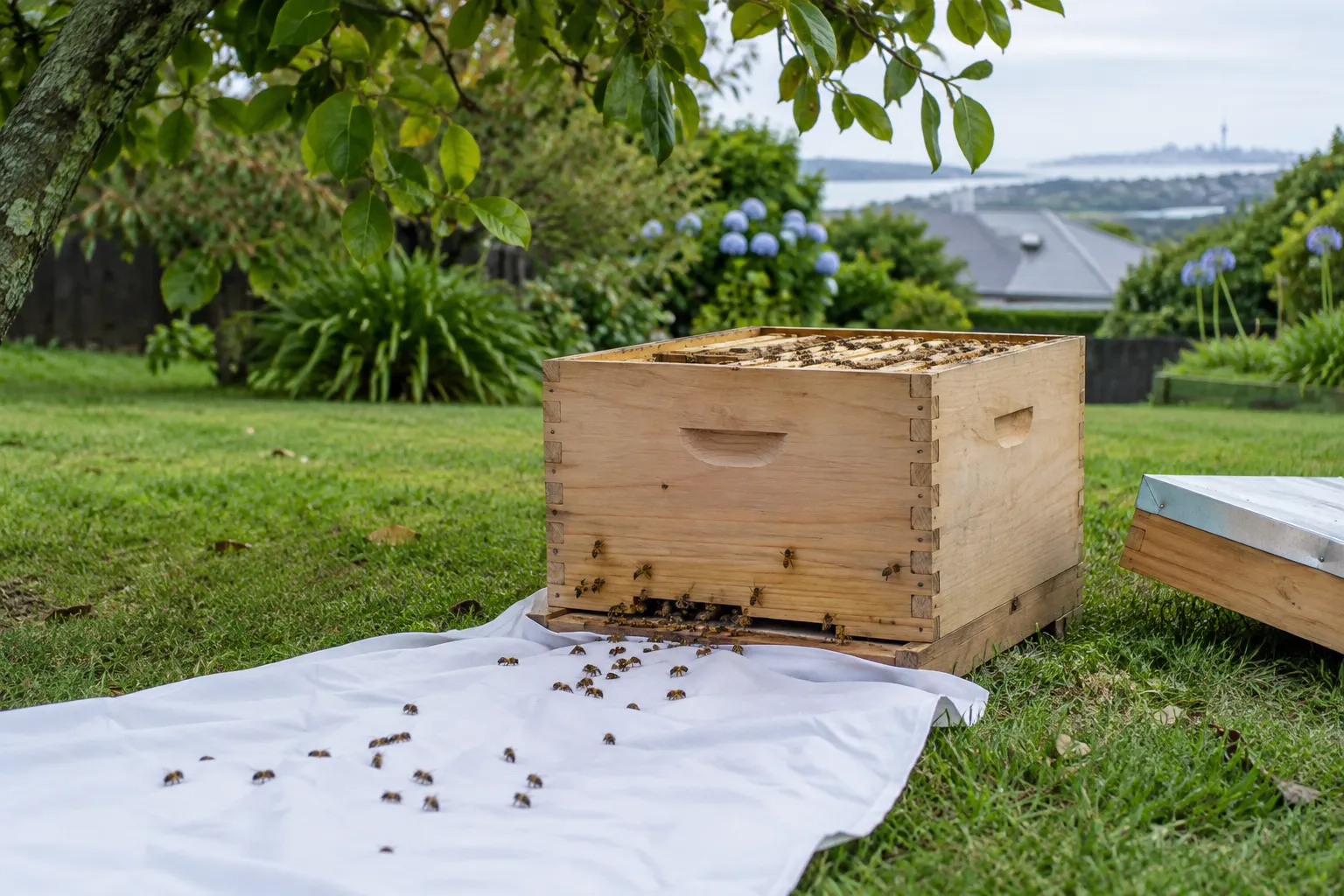
The natural way to get rid of a bee swarm is to let it leave or have it collected. A honey bee swarm is a colony between homes, and most move on within a few hours to a day or two. If it stays, or it is somewhere you can't wait, a local beekeeper can box it up and take it away to a hive, often for free in Auckland. You don't need sprays, smoke or home remedies, and using them can push the bees into your walls. This guide covers waiting it out, getting a swarm collected, what not to do, and how to stop swarms near your house. It is part of our guide to bee swarm removal in Auckland.
How do you get rid of a bee swarm without killing it?
Keep people and pets away, leave the swarm alone, and call a swarm collector. In Auckland, the Auckland Beekeepers Club runs free swarm collection through volunteer collectors, and Honey and Bees New Zealand lists collectors nationwide. The collector boxes up the bees, queen and all, and settles them in a hive, so nothing is killed.
Step by step:
- Check it is a swarm. A swarm is a cluster of bees hanging in the open, often the size of a football or bigger, on a branch, fence, post, letterbox or car. Bees going in and out of a hole in a wall are not a swarm: they are an established colony.
- Keep everyone back. Bring children and pets inside and close nearby windows.
- Take a photo from a safe distance. Collectors often ask for one.
- Call a collector. Tell them where the swarm is, how high, what it is hanging from, roughly how big it is, and how long it has been there.
- Leave it alone until they arrive. Don't spray, hose or knock the cluster.
Will a swarm of bees go away on its own?
Usually, yes. A swarm rests while scout bees look for a new home, then flies off once they choose one. The University of Georgia's bee lab says a swarm usually moves to a permanent home within 24 hours, and Clemson Extension notes a few stay for several days. If it is in a harmless spot, waiting is a perfectly good option.
The catch is where it goes next. A swarm that can't find a hollow tree sometimes picks a gap in a house: a wall cavity, a roof space, a chimney or under a floor. Watch the swarm while you wait. If you see the cluster shrinking while bees stream in and out of a gap nearby, call a collector at once, because once comb is built inside, the job becomes a bee removal from a wall or roof.
Can you catch a bee swarm yourself?
Beekeepers catch swarms all the time, with a box, a sheet and a bee suit. If you are not a beekeeper, it is better to leave it to a collector. You can be stung, the queen can get away, and if you want to keep the bees, you must register as a beekeeper first. A collector does it quickly and safely.
Under the American Foulbrood National Pest Management Plan, anyone who keeps bees in a hive in New Zealand must be registered with NZ Bee Health and Biosecurity, which runs registration through its HiveHub portal. Registration is free, with an annual levy. That is why swarm collectors are almost always registered beekeepers: they are taking the bees home to keep.
Do natural repellents get rid of a bee swarm?
No home remedy reliably moves a swarm. Smells such as peppermint, vinegar or cinnamon may make a few bees avoid a spot, but a swarm leaves when its scouts find a home, not because of a smell. Smoke and water can agitate the bees or knock the cluster apart, which makes stings more likely, not less.
Honey and Bees New Zealand specifically advises against spraying swarms with insecticide, because it can make the bees sick or kill them. Swarming bees are not aggressive or inclined to sting unless provoked, so the gentlest approach, leaving them alone, is also the safest.
What should you not do with a bee swarm?
Don't spray it, hose it, throw things at it, light fires or smoke near it, or try to block it in. Don't try to move it into a box unless you know how. And don't assume a cluster of bees is wasps: Honey and Bees New Zealand asks people to check, because honey bee swarms are routinely mistaken for wasps and sprayed.
Also avoid:
- Mowing, trimming or using a leaf blower near the swarm
- Standing directly under it to take photos
- Leaving pets tied up nearby
- Covering it with a sheet or bin, which can trap bees and make them defensive
How do you stop bees swarming near your house?
You can't stop wild honey bees from swarming, but you can make your house less attractive to a swarm looking for a home. Seal gaps in cladding, eaves, soffits, vents and around pipes before swarm season, which in New Zealand runs from about August to January. Check spots where bees nested before, since those attract new swarms.
If the swarms come from a neighbour's hive, talk to them first. Auckland Council's Animal Management Bylaw requires urban beekeepers to take reasonable steps to prevent nuisance, including in relation to swarming, hive position and bee temperament. If talking doesn't help, you can raise it with Auckland Council.
Questions people ask
Is swarm collection free in Auckland?
Often, yes. The Auckland Beekeepers Club says its swarm collection is free, done by independent volunteer collectors. Some businesses also collect swarms in the open for free. You may pay if the swarm is very high, hard to reach or has moved into a building. Our guide to bee removal cost has the price ranges.
Do bees swarm in winter?
Rarely. Swarming in New Zealand can begin as early as August and runs until January, with spring the peak. In winter, colonies cluster inside their hive or nest to stay warm and don't have the spare bees or food to split. A cluster of bees you see in winter is more likely to be an established colony than a swarm.
Can I keep a swarm that lands in my garden?
You can, but only if you register as a beekeeper first and give the bees a proper hive. Every beehive in New Zealand must be registered under the American Foulbrood National Pest Management Plan. If you don't want to keep bees, a collector will happily take the swarm.
What if the swarm has already moved into my wall?
Then it is no longer a swarm but a new colony, and it will start building comb within days. Call a specialist quickly. A colony that has only just moved in is much easier to remove than one that has been there for months. Our page on bees in walls and roofs explains what removal involves.
Sources
- Honey and Bees New Zealand, Honey bee swarms
- Auckland Beekeepers Club, Free swarm collection
- University of Georgia Bee Lab, Honey bee swarms and bees in walls
- Clemson Cooperative Extension, Frequently asked questions about honey bee swarms
- NZ Bee Health and Biosecurity, Apiary registration
- Auckland Council, Animal Management Bylaw
Last updated