A swarm has just landed: the first hour
A loud cloud of bees, then a hanging cluster on a branch or fence. Here is what to do, and what not to do, while the bees decide where to live.
Checked
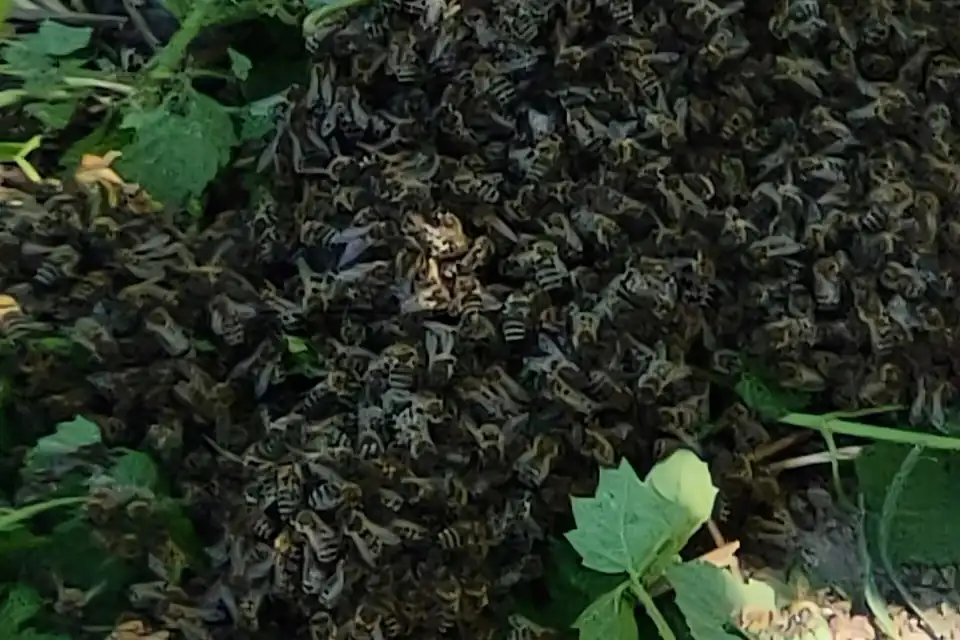
Most swarms arrive the same way. On a warm day in spring, the air fills with thousands of bees flying in loose loops, loud enough to hear indoors. Within ten to twenty minutes they gather on one spot around their queen and form a hanging cluster. That cluster is the swarm. In the first hour your job is simple: keep people safe, leave the bees undisturbed, and get a swarm collector on the way.
Minute one: get people and pets inside
While the bees are flying, bring children and pets inside and close nearby doors and windows. Flying swarm bees are not looking for a fight, but a bee caught in hair or clothing will sting, and dogs that snap at bees get stung in the mouth. Once the bees settle into a cluster, the air clears quickly.
If anyone in the house has a known allergy to bee stings, keep them indoors until the swarm is gone, and have their prescribed emergency plan to hand. For any sting that causes breathing trouble or swelling of the face or throat, ring 111.
Don't spray it, hose it or knock it down
This is the mistake that turns an easy job into a hard one. Spraying insecticide or water, throwing things at the cluster or trying to knock it into a bin will:
- Make the bees defensive, so people get stung.
- Scatter the swarm, so it may resettle somewhere worse, like your roof.
- Kill or stress bees a beekeeper would happily collect.
- Leave pesticide on your plants, fence or car.
A swarm left alone is one of the gentlest things in a garden. Treat it like a parked visitor.
Take a photo from a distance
A collector will want to see what they are dealing with. Take a photo or two from at least a few metres back, zooming in rather than stepping closer. Useful details:
- What the bees are hanging from: branch, fence, post, letterbox, car, eaves.
- Roughly how high it is off the ground.
- How big the cluster is: grapefruit, football, rugby ball or larger.
- Whether it is in the open or near a gap in a building.
Ring a swarm collector
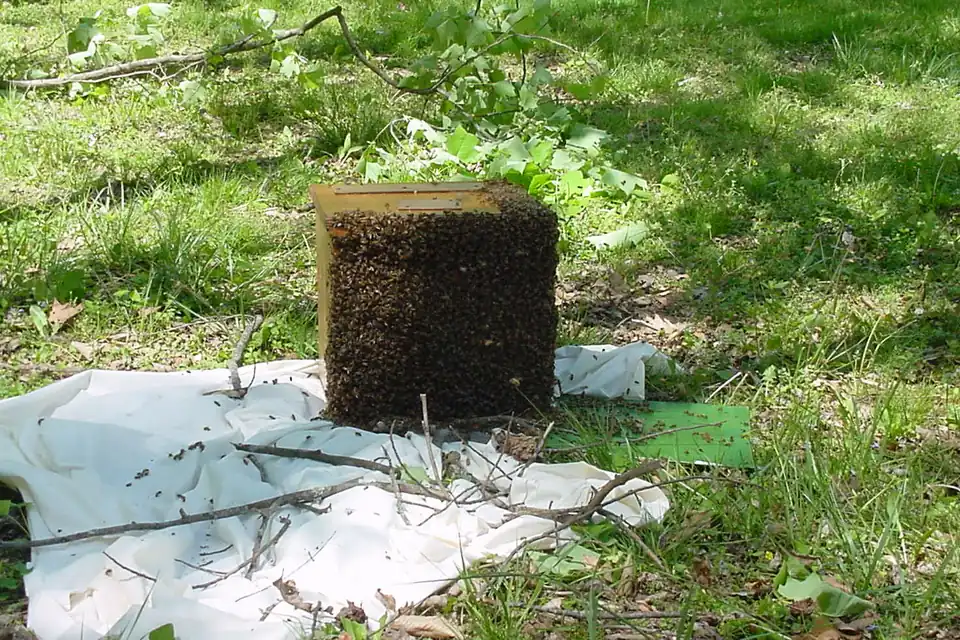

In Auckland, swarm collection is mostly done by beekeepers and volunteers. The Auckland Beekeepers Club takes swarm reports, and Honey and Bees New Zealand keeps a list of collectors by region. A swarm in easy reach is often collected free, because it can become a new hive. Collection is quick: the collector holds a box under the cluster, shakes or brushes the bees in, and often leaves the box in place until evening so stragglers can walk in, as in the photo above. Our collector page explains what to expect.
If the swarm is high in a tree or on a roof where a collector can't safely reach, see swarms out of reach.
Watch where the scouts go
While the cluster waits, scouts are inspecting nearby cavities. Keep an eye out for small groups of bees investigating your eaves, a vent, a gap in the weatherboards or the chimney. If you see bees walking in and out of a gap in the house, especially in a steady stream, the swarm may have chosen your house. Ring us or a collector straight away. A swarm caught at that point is much easier to deal with than a colony that has spent a week building comb inside a wall. The walls and roofs guide explains why.
What not to worry about
- Bees on your washing or windows for a few minutes during the flight: they will move on.
- Bees "attacking" the cluster: that is the normal movement of a swarm, with bees walking over each other.
- The swarm leaving before the collector arrives: that is fine, as long as it doesn't move into your house.
If the swarm is on a car
Leave the car parked, keep people back and ring a collector. Don't drive off with bees on board. The swarm on a car note has the detail.
This note sits under Bee Removal Auckland, where the front page sorts out which bee jobs need a visit and which don't.
Quick answers
How long will the swarm stay?
Usually a few hours to a day, sometimes two or three. If it is still there after several days, it may be failing to find a home, and those are the swarms that sometimes move into buildings.
Can I collect it myself?
Only if you will keep the bees as a registered beekeeper. Every apiary in New Zealand must be registered with NZ Bee Health and Biosecurity. Without that, leave it to a collector.
Is a swarm dangerous to walk past?
Not if you give it space and don't disturb it. Walk around at a few metres' distance and keep dogs on a lead.