Swarm or established hive: how to tell
A swarm is a colony between homes and usually leaves on its own. An established hive has built comb and is staying. The difference decides who you call and what it costs.
Checked
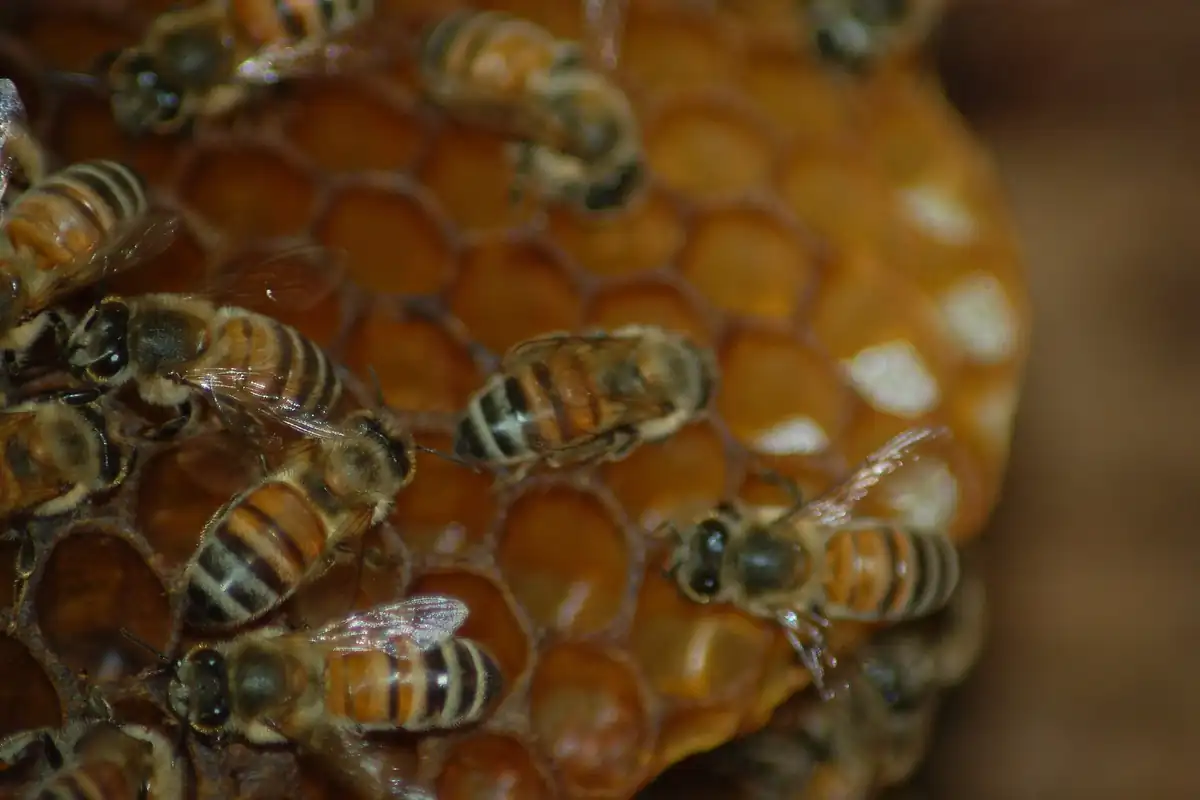
The same honey bees can be either a swarm or a colony, depending on a few days. A swarm is a cluster of bees, with a queen, resting in the open while scouts look for a home. It has no comb, no brood and no honey, and it usually leaves within a day or two. An established hive, also called a colony or nest, has chosen a cavity, built wax comb and started raising young. It isn't going anywhere. Swarms are often collected free; established hives inside buildings are paid work.
Check one: can you see the bees?
A swarm hangs in the open as a visible clump, from the size of a grapefruit to bigger than a rugby ball, on a branch, post, fence, eave or car. An established colony is usually hidden: you see bees flying in and out of a gap, but not the nest itself. If you can see the bees but not the comb, and they are in a clump, it is a swarm.
The exception is a colony built in the open, under a deck, a branch or an eave in a sheltered spot. Then you will see sheets of pale or golden wax comb, as in the photo at the top. Comb means an established colony, however exposed.
Check two: what is the traffic like?
Watch for a couple of minutes from a few metres away.
- Swarm: bees crawl over the surface of the cluster, a few fly off and back, and most stay still. There is no steady stream.
- Established colony: a constant two-way stream at one opening. Foragers come back with yellow or orange pollen on their back legs, and bees may stand at the entrance fanning their wings.


Pollen loads are a strong sign. Swarms don't collect pollen, because they have no brood to feed. If returning bees carry pollen into a gap in your house, a colony has moved in.
Check three: how long has it been there?
Most swarms leave within about a day, and nearly all within a few days. If bees have been using the same spot for a week, through cool mornings and rain, you are looking at a colony. Bees still active at the same spot on a sunny winter day are definitely a colony.
Check four: is there a sound or a smell?
An established colony inside a wall or ceiling can often be heard: a steady hum through the lining, louder on warm afternoons. Old colonies may also give off a sweet, waxy smell, and honey can stain plaster or ceilings. Swarms are quiet once settled. The signs of bees in a wall note lists more clues.
Check five: where exactly is it?
A cluster on the outside of something is a swarm. Bees going into something, such as a gap in weatherboards, a soffit vent, a chimney, a tree hollow, a water meter box or a compost bin, are either scouts checking a site or a colony that has moved in. Scouts come and go in small numbers and investigate several places. A colony uses one entrance busily.
Why the difference matters
Swarm: ring a swarm collector. It is often free in Auckland, and quick. If nobody can come, a swarm in the open will usually leave on its own. See finding a swarm collector.
Established colony in a building: a collector usually can't help. The bees, the comb and the honey all need to come out, and the opening needs closing. Killing the bees and leaving the comb causes melting honey, wax moth, robbing bees and disease risk. See bees in walls and roofs and what a cut-out involves.
Established colony outdoors: in a tree or a shed you don't use, it can often be left, or a beekeeper may cut it out to keep the bees. See trees, hedges and gardens.
The in-between stage
There is a short window when a swarm has just moved into a cavity and has only started building comb. If you notice it in the first day or two, act quickly: a beekeeper may still be able to coax the bees out with little damage, and there is little comb to remove. Within a week or two there can be several kilograms of comb. That is why we say: if a swarm starts going into your house, don't wait.
This note sits under Bee Removal Auckland, where the front page sorts out which bee jobs need a visit and which don't.
Quick answers
Can a swarm turn into a hive on my fence?
Very occasionally a swarm that can't find a cavity builds comb in the open, often under a branch or eave. That is an exposed colony, and it usually fails over winter. A beekeeper may want it while it is small.
Do established hives swarm?
Yes. A healthy colony in a wall or tree may swarm every spring, so a house with a colony in it may also see swarms nearby.
Are the bees in my tree a swarm or a hive?
If they are going in and out of a hole in the trunk, it is a colony. If they hang in a clump on a branch, it is a swarm.