Bees in Grey Lynn
Close-packed villas, narrow side yards, backyard hives over the fence and community gardens on every other street. Grey Lynn's bee problems are about tight spaces and close neighbours.
Checked

Grey Lynn, with Westmere, Arch Hill and the western edge of Ponsonby, is some of Auckland's most tightly built older housing. Streets of kauri villas and 1920s bungalows sit on narrow sections, often less than two metres apart, and much of the area is covered by the special character rules that protect the look of the streetscape. Gardens are small but full, and urban beekeeping is popular. All of this makes bee jobs here a matter of working in tight corners with people close by.
A swarm from a hive two doors down
Hobby beekeeping is common in the inner west. Auckland Council's animal management bylaw allows bees in urban areas as long as they don't create a nuisance, and every keeper must register with NZ Bee Health and Biosecurity. Good keepers manage their hives to reduce swarming, but some swarms still get away in spring.
If a swarm lands in your garden, the friendliest first step is to knock on a neighbour's door if you know they keep bees: they may want it back and can usually collect it quickly. If not, report it through the Auckland Beekeepers Club. The neighbours' bees note explains what the bylaw covers and how to raise a concern.
Where colonies hide in a villa row
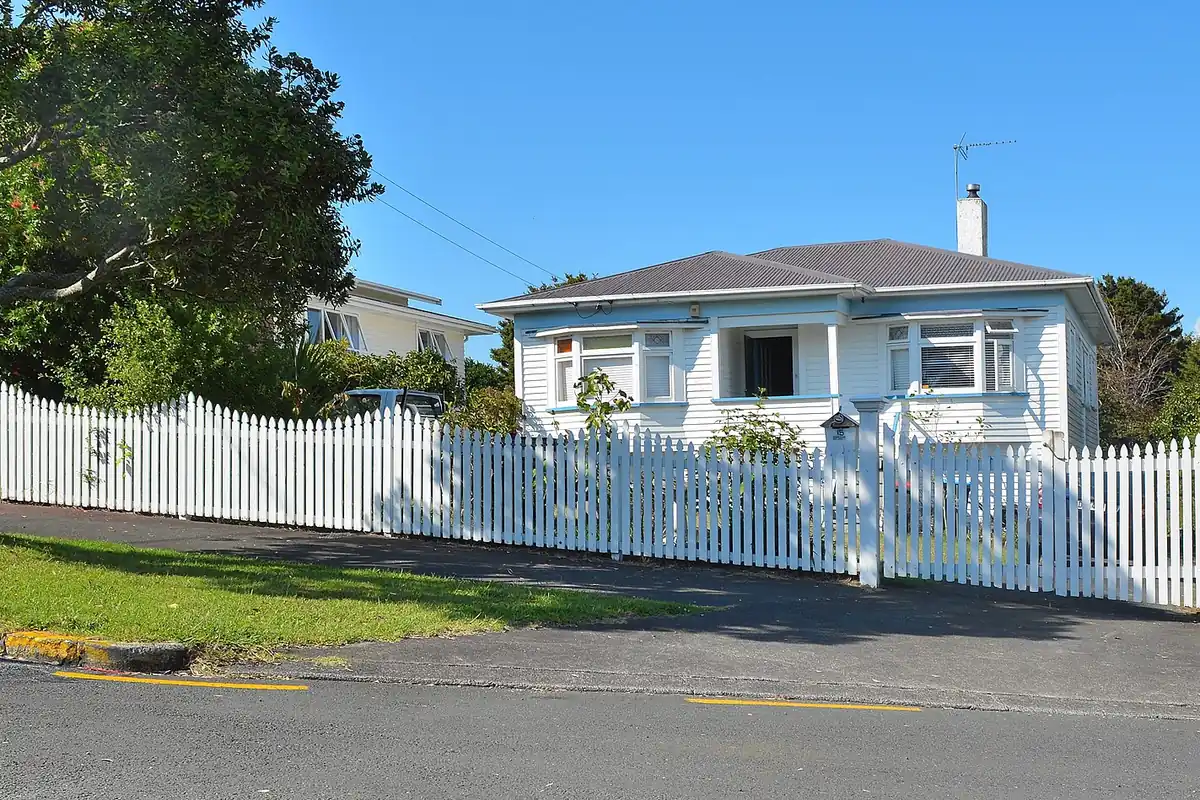

Timber houses of this age leak air in a hundred places, and bees find them. The usual spots in Grey Lynn:
- The lean-to roof at the back, where the kitchen and bathroom were added and the junction with the main roof was never perfect.
- Bay windows facing the street, with framed boxes under the sills.
- Chimneys in the front rooms, often unused and loosely capped.
- The gap under the front veranda, behind lattice or old boards.
- Ceilings in renovated houses, where downlights were cut into an old ceiling and the roof space above opens straight onto them.
Bees settling in these places are not a sign of a neglected house. Even well-kept villas have gaps somewhere. The chimneys page and the roof space page explain how those two are handled.
Working in a narrow side yard
Many Grey Lynn houses have a side yard barely wide enough to walk down, with the neighbour's wall on the other side. If the bees are entering high on that wall, a ladder may not fit at a safe angle, and work may need to happen from the roof, from inside the roof space, or from the neighbour's side with their agreement.
Before a visit, it helps to:
- Tell your neighbour that bee work is planned, especially if the entry is on the shared side.
- Clear the side yard of bins, bikes and plant pots.
- Know where your roof space manhole is and whether it can be reached.
Neighbours are usually relieved rather than annoyed: a colony on a shared boundary affects them as well.
Special character and repairs
On a villa or bungalow in a special character area, replacing original weatherboards, bay windows or decorative timber with a different design can need council approval. Lifting and refixing a few boards to get bees out, or replacing them like for like, is normally treated as maintenance. If more than that is needed, talk to Auckland Council first. When you ask for a quote, say the house is a villa or bungalow so the visit allows time for careful work. The cut-out page shows what is involved.
Community gardens and bumble bees
The area's community gardens and tight back gardens support plenty of bumble bees. A nest in a raised bed, a compost bin or a stack of pots usually lasts a single season. Gardeners often prefer to leave them, as bumble bees are good pollinators of tomatoes, beans and berries. If one is in the way, moving a bumble bee nest explains the options.
Costs and prices
A swarm from a neighbour's hive often goes back to the neighbour for nothing. Villa colonies are priced once someone has looked at the side yard and the boards. As a yardstick, an Auckland beekeeper's business advertises $210 for a wall-cavity bee removal and doesn't mention GST or repairs, and a Wellington operator lists $140, GST in, for each bumble bee nest. Tight side yards and period timber add time. See the costs overview.
Renovations that open a door for bees
Grey Lynn houses are renovated constantly, and building work often creates the very gaps a swarm looks for. Scaffolding goes up, weatherboards come off for re-piling or rewiring, a skylight is cut in, or an old chimney is taken down to the roofline and left with a temporary cover. If that happens in spring, scouts find the opening within days. Ask your builder to keep openings covered with mesh or ply during swarm season, from September to December, and to check soffits and chimney caps before the scaffold comes down. If bees do move in mid-renovation, deal with them before linings go back on: it is far easier to lift out comb from an open wall than to cut into a freshly plastered one.
Other parts of the isthmus
Remuera has bigger sections and brick as well as timber. Titirangi is the bushy west. The Auckland areas page lists them all.
The rest of what we cover, from swarms to wall cut-outs, starts on our page about Auckland Bee Help.
Quick answers
My neighbour's bees are all over my garden. Can I make them move the hive?
Bees foraging on your flowers is normal and not a nuisance under the bylaw. Repeated swarming, bees crowding a doorway or hives placed right against your boundary might be. Talk to your neighbour first, then the council if needed.
Can a swarm collector get into my back garden?
Yes, if you let them through. Many collectors are used to tight inner-city access. Tell them about steps, gates and dogs when you report the swarm.
Bees are coming through my downlights. What should I do?
Turn the lights off, close the room, and put a towel under the door. Bees come towards light. A colony in the roof space above needs a visit; the bees inside the house page explains what to do in the meantime.