Bees in the East Coast Bays
From Castor Bay up to Long Bay, the bays share cliffs, pohutukawa and a sea breeze. Bees here follow the flowering coast, and the houses on the ridges give them plenty of roof spaces to try.
Checked

The East Coast Bays run up the North Shore's Hauraki Gulf coast: Castor Bay, Campbells Bay, Mairangi Bay, Murrays Bay, Rothesay Bay, Browns Bay, Torbay and Waiake, then Long Bay and its regional park. Each bay is a beach at the foot of a valley, with houses climbing the ridges on either side and the busiest shops in Browns Bay. Most homes date from the 1960s onward, with a big run of plaster-clad and brick houses from the 1980s and 1990s, and new streets at Long Bay since the 2010s.
Why the coast gets so many swarms in late spring
The coast flowers hard from late spring. Pōhutukawa along the cliffs and beach reserves usually blooms from November into January, and coastal gardens add flax, hebe, lavender and agapanthus. Colonies that have built up in September and October are crowded by then, and swarming peaks across Auckland from September to December.
So a cluster of bees on a beach-reserve pōhutukawa, a clifftop fence or the side of a parked car is a familiar sight in the bays. The bees are resting, not attacking, and most move on within a day. Leave them, keep children and dogs back and ring a swarm collector. Honey and Bees New Zealand lists collectors by region, and many collect easy swarms free. The what to do in the first hour note has the details.
Clifftop houses and the roof space
Ridge and clifftop houses in the bays take the full weight of the easterly and north-easterly winds. That shapes where bees settle. Rather than an exposed wall, a swarm is more likely to choose the sheltered side: a soffit under the eaves, a gap where a pipe passes through the cladding, or the roof space above a garage.
Roof-space colonies are common in houses from this era because their roofs have generous voids and a lot of soffit length. Signs to watch for:
- A steady line of bees going in and out at one point on the eaves, all day, in good weather.
- A hum from the ceiling of one room, loudest on a warm afternoon.
- Bees appearing indoors near a downlight or the manhole.
- Dark staining or a sweet smell on a ceiling, which can mean honey or comb close behind it.
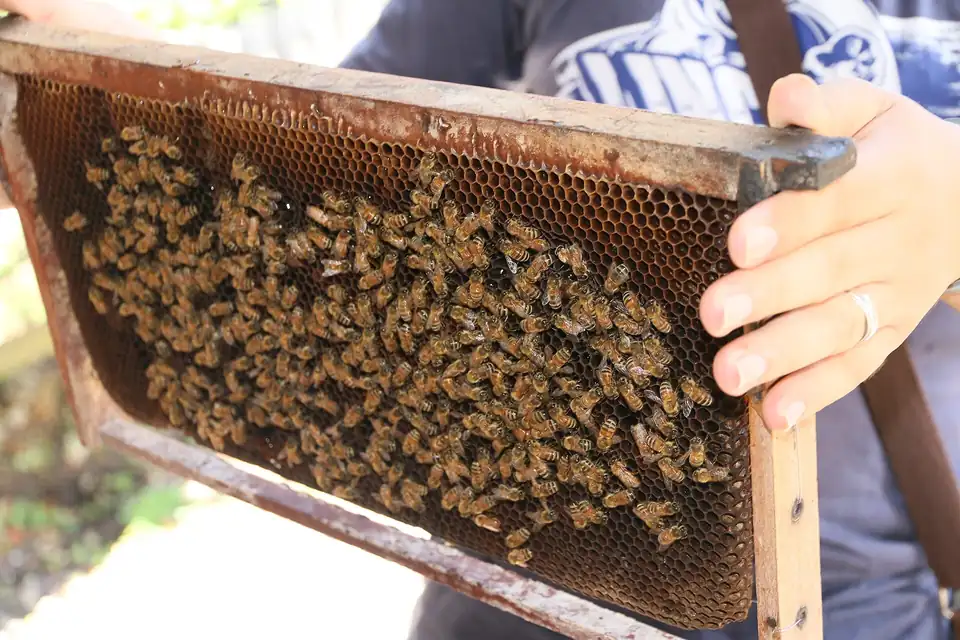

A roof colony builds comb like the frame in this photo, but in irregular sheets hanging from rafters or between ceiling joists. Getting it out means working in the roof space or opening the soffit or ceiling. The ceilings and roof spaces page explains how that is approached.
Plaster-clad houses from the 1990s
A number of bays houses have monolithic cladding: a plaster finish over sheet or polystyrene backing, common in the 1990s and early 2000s. Bees get into these through cracks, unsealed penetrations and gaps around window heads. Cutting into monolithic cladding needs care, because a poor repair can let water in, and a weathertightness problem costs far more than the bees. When you ask for a quote, say what the cladding is. Any repair should be done by someone who knows the system, and the technician who removes the bees can tell you how big an opening was needed.
Long Bay's newer streets
The newer houses in the Long Bay development are less attractive to swarms. Modern cavity construction, sealed soffits and smaller voids leave fewer places to settle. The problems there tend to be outdoor ones: bumble bees in landscaping bark, swarms in young street trees, and bees drinking from pools in summer. If bees are crowding a pool edge, the bees at the pool and birdbath note explains why and what helps.
Bumble bees in coastal gardens
Bumble bees do well in the sheltered back gardens of the bays. Queens look for old rodent holes, dry grass and bark mulch in early spring, and a nest might grow to a couple of hundred bees before dying out in late summer or autumn. They rarely sting unless pressed or trodden on. Where a nest is in a lawn, path edge or kids' play area, it can be dealt with. The bumble bee guide shows how to decide.
Price guide for the bays
Free collection is common for swarms in easy reach. For other work, the few published figures we found are one Auckland beekeeping business's $210 for removing bees from a wall cavity (GST and repairs not stated) and a Wellington pest controller's $140 including GST per bumble bee nest. Two-storey clifftop houses, roof spaces and plaster cladding all tend to add time. The costs overview sets out every figure with its source.
Neighbouring areas
Glenfield lies inland with bush gullies and decks over slopes, and to the north the Hibiscus Coast has the same beach-and-ridge pattern on a bigger scale. See all Auckland areas.
The rest of what we cover, from swarms to wall cut-outs, starts on our page about bee removal around Auckland.
Quick answers
Bees are all over my pohutukawa. Is that a nest?
Usually not. A flowering pohutukawa draws foragers from hives and colonies across the area. If the bees are spread through the flowers, they are feeding. A tight hanging cluster is a swarm; a stream into one hole in the trunk is a colony.
Will a swarm on my clifftop fence go over the edge?
It will fly when the scouts have chosen a site, often within hours. Don't try to move it towards the edge, and don't hose it. A collector can box a swarm on a fence quickly if one can come before it leaves.
Is it safe to swim at the beach with bees about?
Bees at a beach are usually foraging or drinking and pay little attention to people. Avoid walking barefoot through clover on the reserves, where bees feed low down.