Signs you have bees in your walls
A colony inside a wall can stay unnoticed for weeks. These are the signs to look and listen for, and how to work out roughly where the comb is before anyone opens the wall.
Checked
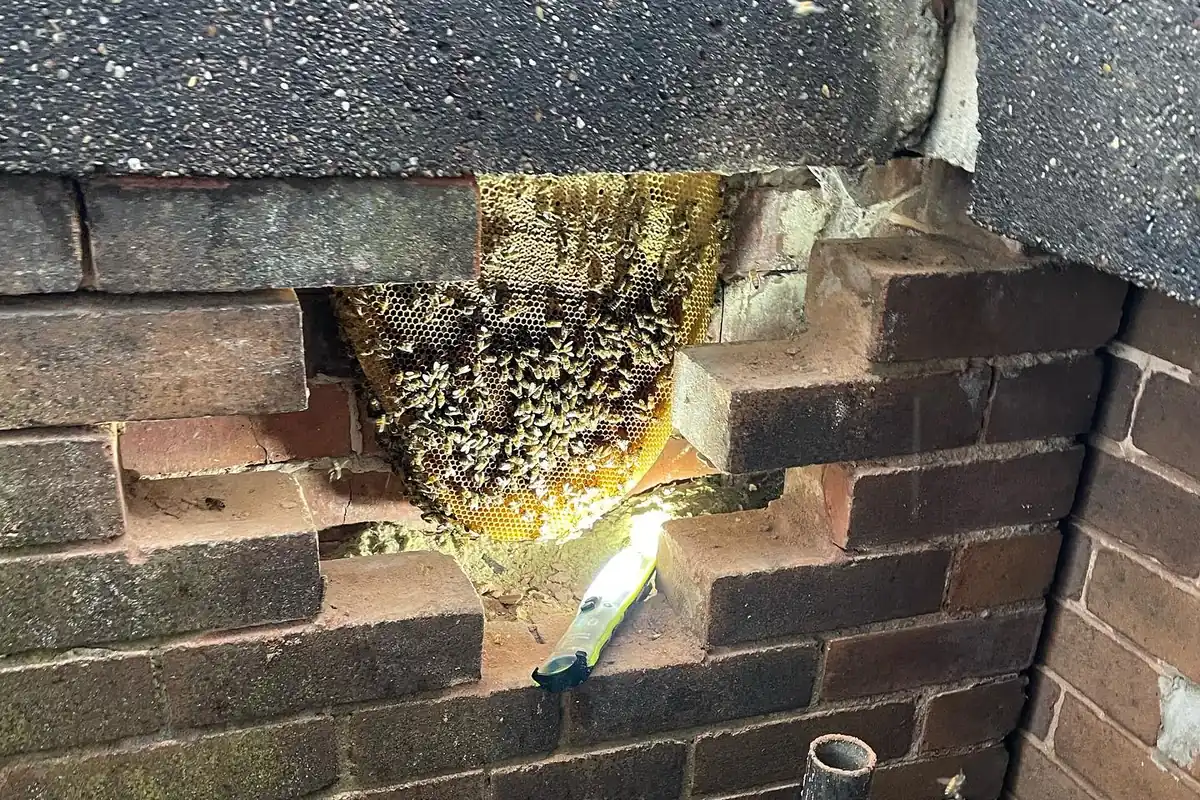
The clearest sign of bees in a wall is a steady stream of honey bees flying in and out of one small gap in the outside of the house, all day, whenever the weather is fine. Add a hum through the lining, bees carrying pollen, and odd bees turning up indoors, and you can be fairly sure a colony has built comb inside. The photo above shows what that looks like once the bricks are lifted: sheets of comb filling the cavity. Here is how to read the signs.
A busy entrance in one spot
Stand a few metres back on a warm day and watch the outside of the house. A colony uses one main entrance, sometimes two, and the traffic is constant: bees leaving in a straight line, others landing and walking straight in. Common entry points are:
- A gap where weatherboards meet a corner board or window frame.
- A weep hole in brick veneer.
- A soffit vent or a gap at the eaves.
- Where a pipe, cable or flue passes through the wall.
- The top of a chimney.
A few bees investigating a gap for a few minutes is not the same thing. Those are scouts from a swarm, or foragers checking for water. Traffic that is still there the next day and the day after is a colony.
Pollen on the back legs
Returning foragers carry pollen packed into baskets on their hind legs: little balls of yellow, orange or grey. Pollen feeds larvae, so bees bring it home only when there is brood in the nest. If you see pollen going into a gap in your wall, the colony is raising young, and it is established.
A hum you can hear indoors
Put your ear, or a glass, against the inside of the wall or ceiling near the entrance. A colony of tens of thousands of bees makes a steady buzzing hum, loudest on warm afternoons and evenings when the bees are fanning to cool the nest. A wall that is warm to the touch in one area can also point to the nest. A thermal camera, which some technicians carry, shows the warm patch clearly.
Bees inside the house


Bees sometimes wander from the nest into the house through gaps around downlights, switch plates, skirting boards or window frames. They head for light, so you find them on windows or around light fittings, often dozy and confused. A few bees indoors each day near the same room is a strong sign of a nest in that wall or ceiling. The bees inside the house page covers what to do while you wait for help.
Staining, sticky patches and smells
Older colonies store a lot of honey. If the comb collapses on a hot day, or the colony dies and the comb starts to break down, honey can soak through linings. Signs include:
- Brown or dark staining on a ceiling or wall.
- A sticky patch on the outside cladding below the entrance.
- A sweet, waxy or slightly fermented smell.
- Ants or wax moths around the entry, drawn to the honey and wax.
These usually mean an older or failing colony, and the job is more urgent.
Working out where the nest is
The comb usually sits close to the entrance, often above it, because bees build upward and inward. In a timber-framed wall, comb is normally contained between two studs, though older colonies can spread into the next bay. Before anyone opens the wall, it helps to note:
- Exactly where the entrance is, measured from a corner or window.
- Where the hum is loudest inside.
- Which room, if any, has bees appearing.
That narrows the opening needed and keeps repairs small. The wall cutaway diagram shows the usual layout.
What not to do once you are sure
- Don't block the entrance. Trapped bees look for a way out, often into the house.
- Don't spray into the hole. Read why not to spray a wall colony.
- Don't drill holes and pour things in. You risk wiring, linings and a bigger mess.
Ask for an inspection, and if possible a beekeeper's view on rehoming. The cut-out page explains the job.
This note sits under bee nest and colony removal in Auckland, where the front page sorts out which bee jobs need a visit and which don't.
Quick answers
Could it be wasps in the wall?
Yes. German and common wasps also nest in walls and roof spaces. Wasps are shiny yellow and black with almost no hair. See the bee or wasp guide.
Bees disappeared from my wall. Is the problem over?
Not necessarily. A colony that dies or leaves still leaves comb and honey, which can attract robbing bees, wax moth and new swarms. Have it checked.
How big can a colony in a wall get?
Large. Colonies left for a year or more can fill several bays with comb and hold tens of thousands of bees.