Swarms that are high up or hard to reach
Not every swarm hangs at shoulder height. When bees settle high in a tree, on a roof or deep in a hedge, the options change, and sometimes the best one is to wait.
Checked
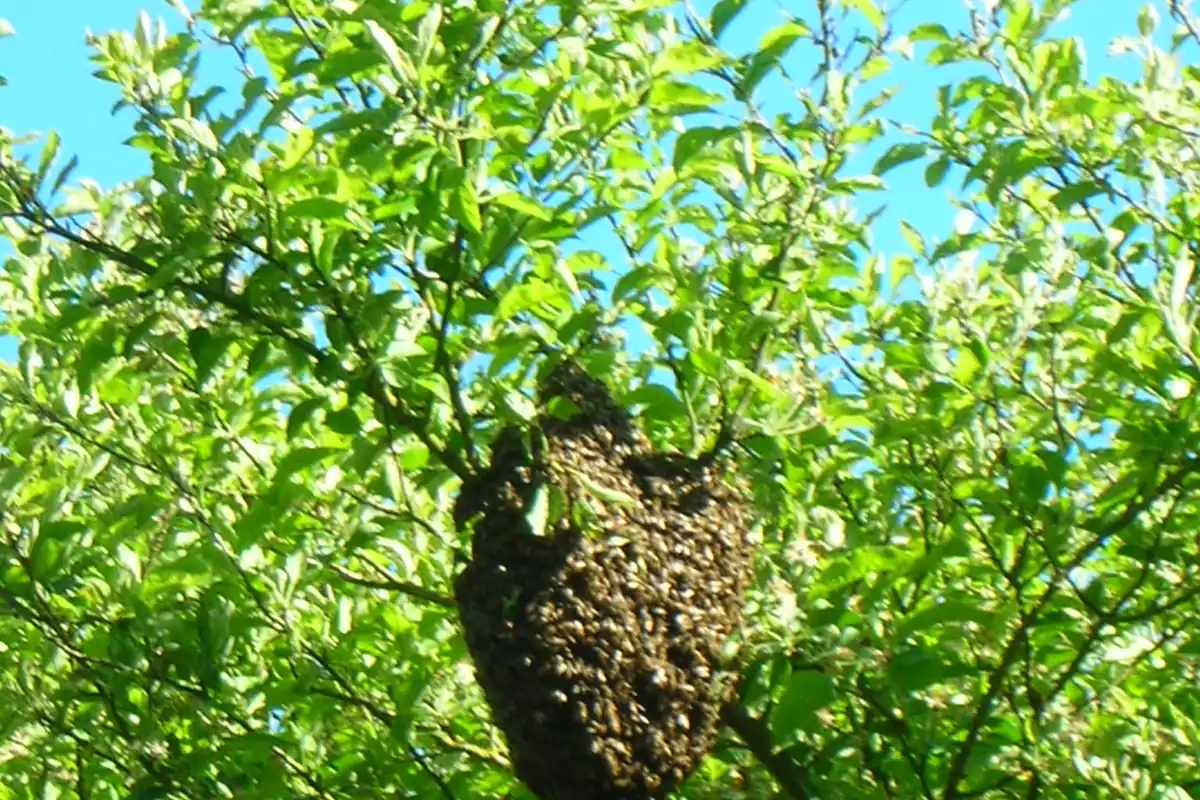
A swarm that lands high in a tree or on a roof is still just a swarm: calm, temporary and usually gone within a day or two. If it is in the open and nobody is at risk, the simplest and safest choice is often to leave it alone and watch where it goes. Paid help makes sense when the swarm is over a doorway, a path or a play area and won't leave, when it is in a gutter or on the roof edge and scouts are checking gaps under the roofing, or when the bees have started going into the building. Reaching a high swarm safely needs the right gear, which is why it is no longer a free collection.
Should you leave it?
Leave it, and watch, if:
- It is high in a tree in the open, away from doors and paths.
- It arrived today or yesterday.
- You can see it hanging in a clump, not entering a gap.
Most swarms move on within about a day once scouts agree on a new home. Chasing a swarm 10 metres up a gum tree costs money and adds risk, for a problem that may solve itself by tomorrow. Keep children and pets back, and look again in the morning.
When to ask for help
- Over a busy spot: a swarm hanging above a front door, a driveway, a school gate or a café table, where people can't avoid walking underneath.
- On the roof or in the gutter: scouts may slip under roofing, flashings or into the soffit. A swarm here can become a roof colony within days. See ceilings and roof spaces.
- In a chimney top: see bees in a chimney.
- Deep in a hedge or bush: hard to box without cutting branches.
- Still there after several days: a swarm that can't find a home sometimes starts building comb in the open.
How high swarms are reached


Depending on the site, a technician or collector may use:
- Extension ladders, properly footed and tied, on firm level ground.
- A pole and a bucket or bag, to dislodge a cluster from a branch into a container without climbing.
- An elevated work platform or cherry picker, for tall trees or roofs where a ladder can't stand safely.
- Roof access gear, such as anchors and harnesses, for work on a roof.
Anyone paid to work at height must manage the risk of falls under the Health and Safety at Work Act 2015, and WorkSafe's guidance applies. Steep bush sections, like those around Titirangi in the photo, often rule ladders out, so the job is planned around what can be done safely, or left.
Swarms in hedges and shrubs
A swarm inside a thick hedge or a shrub may need some pruning to reach. Often the bees can be encouraged to walk up into a box placed on top, if the queen is coaxed in. It is slower than a branch shake but avoids heavy cutting. Some swarms in dense shrubs simply leave on their own.
Swarms that have moved in
Once you see bees going in and out of a gap, rather than hanging in a clump, it is a colony, not a swarm. That needs a different job: finding and removing the comb. See bees in walls and roofs and swarm or established hive.
What it costs
A swarm in easy reach is often collected free. A swarm that needs height equipment is paid work, and the price depends on the gear, time and travel. No Auckland business we found publishes a price for high swarms. For context, the nearest published figures are one Auckland beekeeping business's $210 for removing bees from a wall cavity (GST and repairs not stated) and a Wellington firm's $140 including GST for bee nest work. The swarm costs page explains what moves the figure.
What to tell us
- How high the swarm is and what it is on.
- The ground beneath: lawn, paving, slope, garden bed, roof.
- How long it has been there.
- Whether bees are going into anything.
- A photo from a distance.
If the bees here don't match yours, the front page on Bee Removal Auckland sets swarms, bumble nests and wall colonies side by side.
Quick answers
Can I hose a high swarm to make it leave?
No. Water stirs bees up and scatters them, and they may land somewhere worse, such as your roof. Leave it to settle and move on.
Will the fire service remove a swarm?
Swarms are not an emergency. Ring a swarm collector, or ask us if it is high or has gone into the house.
A swarm is on my two-storey roof. Is it urgent?
Watch closely. If bees are going under the roofing or into the soffit, ask for a visit quickly, before comb is built.