Bees in Howick and nearby suburbs
Howick is one of Auckland's oldest settlements, but most homes around it are from the 1970s to the 2000s. Those houses have their own favourite entry points for bees, mostly up at the eaves.
Checked

Howick was founded in 1847 as a settlement for Fencibles, retired soldiers and their families, and the village around Picton Street and Stockade Hill still has some of that early character. The suburbs that surround it, from Pakuranga and Bucklands Beach to Cockle Bay, Shelly Park, Botany and Dannemora, grew mostly from the late 1960s to the 2000s. That is a long run of brick-and-tile, weatherboard and plaster homes on generous sections, many with double garages and wide eaves. East Auckland's bee calls are shaped by that housing.
Eaves and soffits: the main way in
Houses built from the 1970s onward usually have wide eaves lined with flat sheet soffits. Over decades, soffit sheets warp at the joins, vents lose their mesh and the scribers along the wall shrink away. A scout bee only needs a gap the width of a pencil.
A colony that gets in at the soffit can build in two places: along the eaves void itself, or up into the main roof space. The signs are much the same:
- A steady line of bees going in at one corner of the eaves.
- Bees patrolling under the eaves in the morning sun.
- A faint hum from the ceiling of the room below.
- Occasional bees finding their way into the house through a downlight or the attic hatch.
Getting bees out of a soffit usually means taking down a section of lining, removing all the comb and refitting or replacing the sheet. The roof space page explains what is involved.
Brick veneer and the cavity behind it

Many East Auckland homes are brick veneer: a skin of brick in front of a timber frame, with a narrow cavity between and weep holes along the bottom course. Bees sometimes use a weep hole or a gap above a window as a doorway and build comb in the cavity. Removal may involve lifting bricks or working from inside through the lining, which takes longer than lifting weatherboards. Don't fill the weep holes while bees are using them; they are there to drain the cavity, and the bees need to come out first.
Village houses and Stockade Hill
The older houses around Howick village, villas and early bungalows, have the timber-house problems found across the isthmus: unlined walls, old chimneys and verandas. Treat them as you would any villa: rehome if possible, take out every piece of comb, and make sure repairs match the original. See what a cut-out involves.
Coastal swarms around the bays
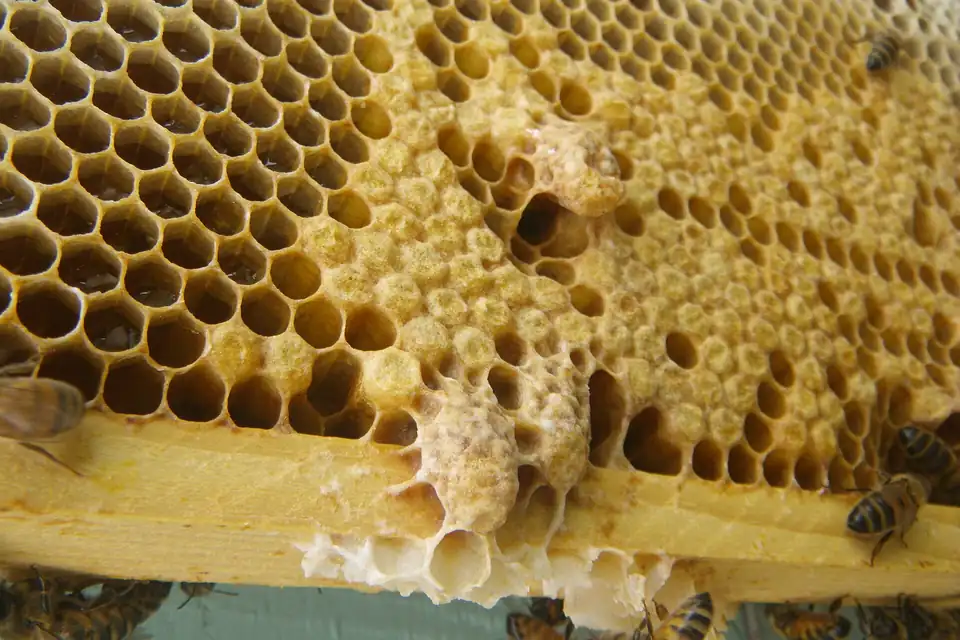
The coast from Bucklands Beach round to Cockle Bay and the Mangemangeroa valley has pōhutukawa, flax and coastal shrubs that flower heavily in late spring and summer. Swarms appear on beach reserve trees, boat sheds and fences from September to December. The photo above shows the queen cells a crowded colony raises before it swarms; once the new queens are ready, half the colony leaves with the old one. A swarm in the open is calm and often collected free. See why bees swarm in spring.
Big gardens and bumble bees
Large sections with lawns, hedges and established gardens give bumble bee queens plenty of nest sites, often in an old rodent hole under a hedge, in a compost bin or under a garden shed. A nest lasts one season. If it is in the way of a lawnmower or a path, see the lawn nest note before deciding what to do.
Getting here and getting up there
East Auckland is spread out, and traffic on the main roads into Howick and Botany can be slow at peak times. Work at height is the main cost factor: many homes are two storeys, and soffits on the upper level need a tall ladder or an access platform on sloping ground. When asking for a quote, say whether the bees are on the upper or lower level, whether the house is brick, weatherboard or plaster, and where a vehicle can park.
What to expect to pay
Coastal swarms around the bays usually cost nothing to have collected. Soffit and brick-cavity colonies are priced on site, and upper-storey eaves take longest. The public price points are thin: $210 is what one Auckland beekeeping firm advertises for getting bees out of a wall cavity, with GST and repair left unstated, and $140 including GST is a Wellington pest controller's per-nest figure for bumble bees. The costs overview lists the sources.
Heat pumps, solar panels and new penetrations
Many East Auckland homes have had heat pumps, ventilation systems and solar panels fitted in the last decade. Each one means a new hole: a pipe run through the wall for the heat pump, a duct through the soffit, cables under the roofing to the panels. Installers usually seal these, but sealant fails in the sun over time, and a gap around a heat pump line is exactly the size a scout bee wants. Walk round the house each winter and look at every place a pipe, cable or duct enters. A strip of fresh exterior sealant or a pipe collar costs very little compared with opening a soffit to take out comb later. The bee-proofing note lists the other gaps worth a look.
Nearby areas
Pukekohe lies south, among market gardens. Across the water, Waiheke Island has its own island logistics. See the Auckland areas page.
The rest of what we cover, from swarms to wall cut-outs, starts on our page about bee removal in Auckland.
Quick answers
Should I just seal the gap in my soffit?
Not while bees are using it. Sealed-in bees look for another way out, often into the house. Have the colony removed, then seal the gap.
Are the bees in my eaves wasps?
Look closely from a distance. Honey bees are brown and fuzzy and fly in a steady line. German and common wasps are shiny yellow and black. The bee or wasp guide helps you tell, and wasps are a job for a pest controller.
Do brick houses get bees less often?
Brick veneer has fewer gaps than old weatherboards, but the eaves, weep holes and the junctions around windows still let bees in.