The yellow-legged hornet in Auckland
An invasive hornet that preys on honey bees was found on Auckland's North Shore in October 2025, and MPI is working to eradicate it. If you see one, report it; don't tackle it.
Checked
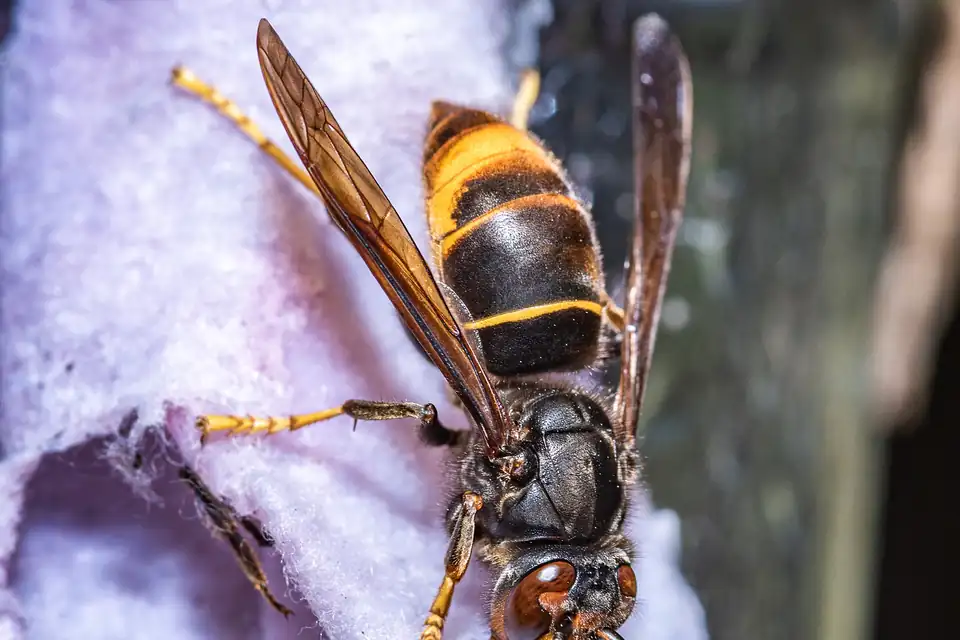
The yellow-legged hornet, Vespa velutina, is an Asian hornet that has spread through much of Europe since the 2000s, where it has become a serious predator of honey bees. New Zealand's first queen was found in Glenfield on Auckland's North Shore in October 2025. Since then MPI, through Biosecurity New Zealand, has been searching for and destroying queens and nests, and reports through the summer of 2025/26 were concentrated around Glenfield and Birkdale. MPI's response is ongoing, and it relies on the public to report sightings. If you think you have seen one, photograph it from a safe distance if you can and report it on 0800 80 99 66 or at report.mpi.govt.nz. Do not try to destroy a nest yourself.
What a yellow-legged hornet looks like
- Size: a worker is roughly 2.5 cm long, bigger than a honey bee or a German wasp; queens are larger.
- Colour: mostly dark brown to black body, with one orange-yellow band near the end of the abdomen and thin yellow edges on the segments in front.
- Legs: the giveaway. The lower legs are bright yellow, as if dipped in paint.
- Face: orange-yellow.
The photo at the top shows the dark body and yellow feet clearly. The European hornet, which is larger and much more yellow and brown, is not established in New Zealand, so a large dark hornet with yellow legs in Auckland should be reported.
How it differs from wasps and bees we already have
| Insect | Body | Legs | Nest |
|---|---|---|---|
| Yellow-legged hornet | Dark, one orange band | Yellow tips | Large paper ball, often high in trees, sometimes in sheds or hedges |
| German and common wasps | Bright yellow and black stripes | Yellow and black | In the ground, walls or roof spaces |
| Paper wasps | Long, slim, reddish or yellow-brown | Dangling in flight | Small open comb under eaves |
| Honey bee | Golden-brown, fuzzy | Dark | Comb in a cavity |
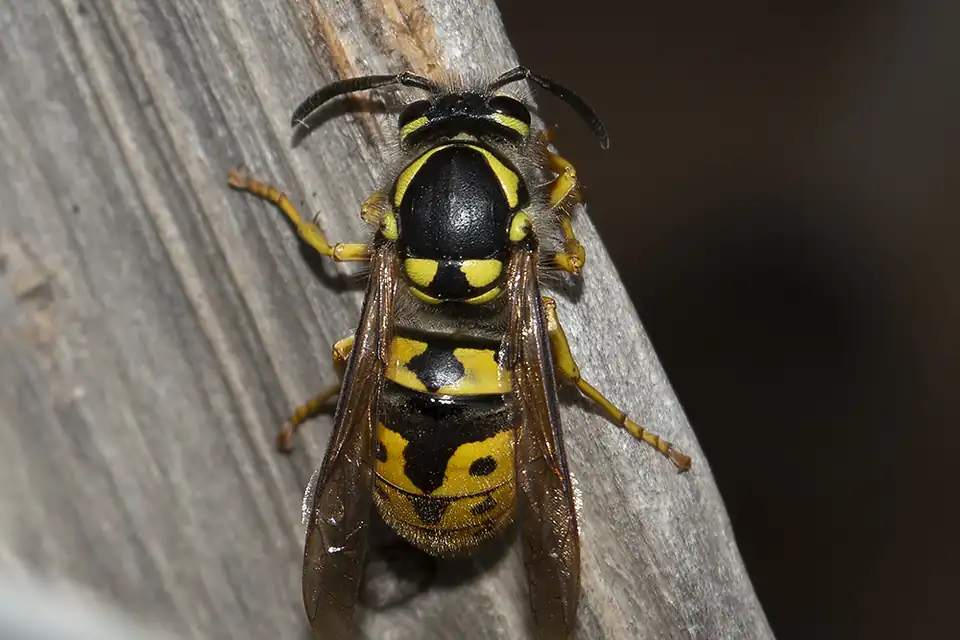

The German wasp in this photo is the familiar late-summer wasp at picnics. It is a pest, but it is not the hornet. Our bee or wasp guide covers all of these.
Why it matters to bees
Yellow-legged hornets hunt insects, and honey bees are a favourite prey. In Europe they hover in front of hive entrances and catch returning foragers, and colonies under attack stop foraging and weaken. They also take native insects. For New Zealand's beekeeping, horticulture and native wildlife, keeping the hornet from establishing is important, which is why MPI treats every sighting seriously.
Where it has been found
The finds so far have been on the North Shore. Recent public reporting placed them around Glenfield and Birkdale. Numbers change as the response goes on, so we don't quote counts here: check MPI's situation page for the current picture. People across Auckland, not just the North Shore, are asked to keep watch, especially in spring when queens start new nests. Our Glenfield area page has local detail.
What to do if you see one
- Keep away from it and don't swat or spray it.
- Take a photo if you can do so safely. A dead specimen is also useful; put it in a sealed container in the freezer.
- Note where and when you saw it.
- Report it on 0800 80 99 66 or online at report.mpi.govt.nz.
What to do if you find a nest
Keep well away. Hornet nests can hold many hundreds of insects, which defend the nest. Don't try to remove or spray it: treating a nest wrongly can scatter hornets and make the response harder. Report it to MPI, who will deal with it. A paper nest in a tree or shed on the North Shore is worth reporting even if you think it is probably wasps.
Is it dangerous to people?
The hornet's sting is painful, and like any sting it can cause a severe reaction in people who are allergic. It is not usually aggressive away from its nest. For a sting causing breathing problems or swelling of the face or throat, ring 111. See the stings page.
Our part
We don't deal with hornets. Any suspected hornet or hornet nest goes to MPI. If a technician visiting for a bee job in Auckland sees something that might be a hornet, they will report it.
This note sits under bee removal in Auckland, where the front page sorts out which bee jobs need a visit and which don't.
Quick answers
Is the yellow-legged hornet the same as the Asian giant hornet?
No. The Asian giant hornet, Vespa mandarinia, is a different and larger species. The one found in Auckland is Vespa velutina.
Should I put out hornet traps?
Follow MPI's guidance. Home-made traps catch many other insects too, including native species and honey bees. Reporting sightings is what MPI asks of the public.
I saw a big wasp in Henderson. Should I report it?
If it looks like the description above, yes. MPI would rather check a report that turns out to be a wasp than miss a hornet.