Leafcutter and mason bees
Perfect half-moons cut from rose leaves, or small bees sealing holes in old timber. These are solitary bees, they don't build hives, and they need no removal.
Checked
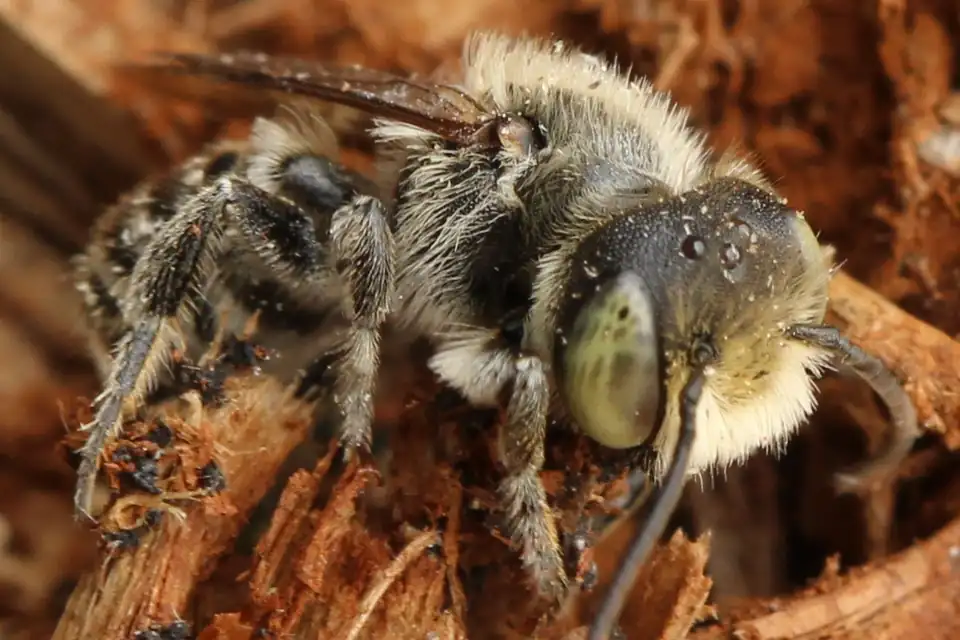
The lucerne leafcutting bee, Megachile rotundata, is a small solitary bee introduced to New Zealand from North America from 1971 to pollinate lucerne grown for seed. Females cut neat oval and round pieces from soft leaves, often roses, and use them to line and cap a row of cells inside a narrow tunnel, such as a hole in wood, a hollow stem or a gap in old timber. Each cell gets pollen, nectar and one egg. The bees don't live in colonies, don't make honey and don't swarm. "Mason bee" is a name used mostly in Europe and North America for related solitary bees that seal their cells with mud; in Auckland, small bees going in and out of holes in timber are more likely to be leafcutter bees or native masked bees.
Signs of leafcutter bees
- Rose leaves with smooth-edged half circles cut from the margins. It looks deliberate, because it is.
- Small grey-brown bees carrying a rolled leaf piece under the body as they fly.
- Holes in old timber, fence posts or drilled blocks plugged with green or brown leaf discs.
- Pollen carried on the underside of the abdomen, not on the legs as in honey bees.
How they differ from honey bees and native bees
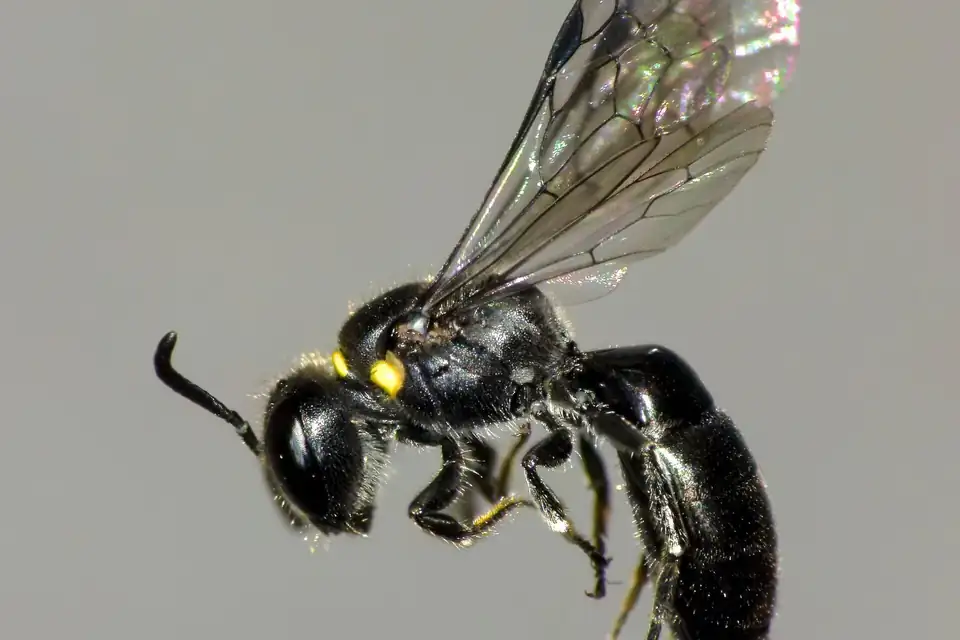

Leafcutter bees are solitary, like New Zealand's native bees. Each female works alone. A row of holes in a post may hold many females, but there is no shared nest and no comb. The native masked bees, Hylaeus, in the photo above, also nest in stems and holes, and are smaller, sleeker and black with pale face marks. Honey bees, by contrast, live in colonies of thousands with wax comb, and bumble bees in seasonal colonies started by a queen. Our native bees note covers the native species.
Are they harmful?
To houses, no. Leafcutter bees use existing holes and soft material; they don't bore into sound timber or mortar. They may use old nail holes, borer holes, cracks in weathered wood or gaps in crumbling mortar, but they don't create structural damage.
To plants, the damage is cosmetic. A rose bush may lose a few dozen leaf pieces over summer, and it recovers.
To people, they are very low risk. Leafcutter bees can sting but rarely do, and the sting is mild compared with a honey bee's.
What about bees in mortar or brickwork?
If small bees are going in and out of gaps in old mortar, look closely. Single bees at many separate holes suggest solitary bees, which can be left. A steady stream into one gap in brick veneer is a honey bee colony in the cavity behind, and that needs attention. See signs of bees in a wall. Crumbling mortar is worth repointing in winter anyway, once any solitary bees have finished.
Do they need removing?
No. A leafcutter bee nest in a post or a pot-plant stake needs nothing done. If they are nesting somewhere you need to repair, such as a window frame you are about to paint, wait until late autumn or winter, when activity has stopped, then fill or replace the timber. The young overwinter inside the cells, so removing the timber in winter removes the next generation. If you would like to keep them, move the piece of wood to a sheltered spot rather than destroying it.
Encouraging them
Leafcutter bees are good pollinators of lucerne, clover and many garden flowers. You can support them by:
- Leaving some dead stems and old wood in a sunny corner.
- Hanging a block of untreated timber drilled with holes of a few different diameters, facing north-east.
- Not spraying insecticide on flowering plants.
- Accepting a few holey rose leaves.
Where to go next
If the bees you are seeing are big, furry and nesting in the ground, read bumble bee nest in the lawn. If they are sleek and yellow-and-black, check the bee or wasp guide. For solitary bees near doors or play areas, the native and solitary bees page explains the options.
This note sits under bee removal in Auckland, where the front page sorts out which bee jobs need a visit and which don't.
Quick answers
Are leafcutter bees native to New Zealand?
The lucerne leafcutting bee is not; it was introduced from North America from 1971. New Zealand's native bees are a separate group of about 27 species.
Can I stop them cutting my roses?
Netting a favourite rose during summer is the only reliable way, and it is rarely worth it. The damage is cosmetic.
Will they come back to the same posts?
Often. Emerging bees tend to nest close to where they hatched, so a good nesting post can be used year after year.