New Zealand's four bumble bee species
Bumble bees are not native here. Four species were brought from England from 1885 to pollinate red clover, and they have been part of New Zealand gardens ever since.
Checked
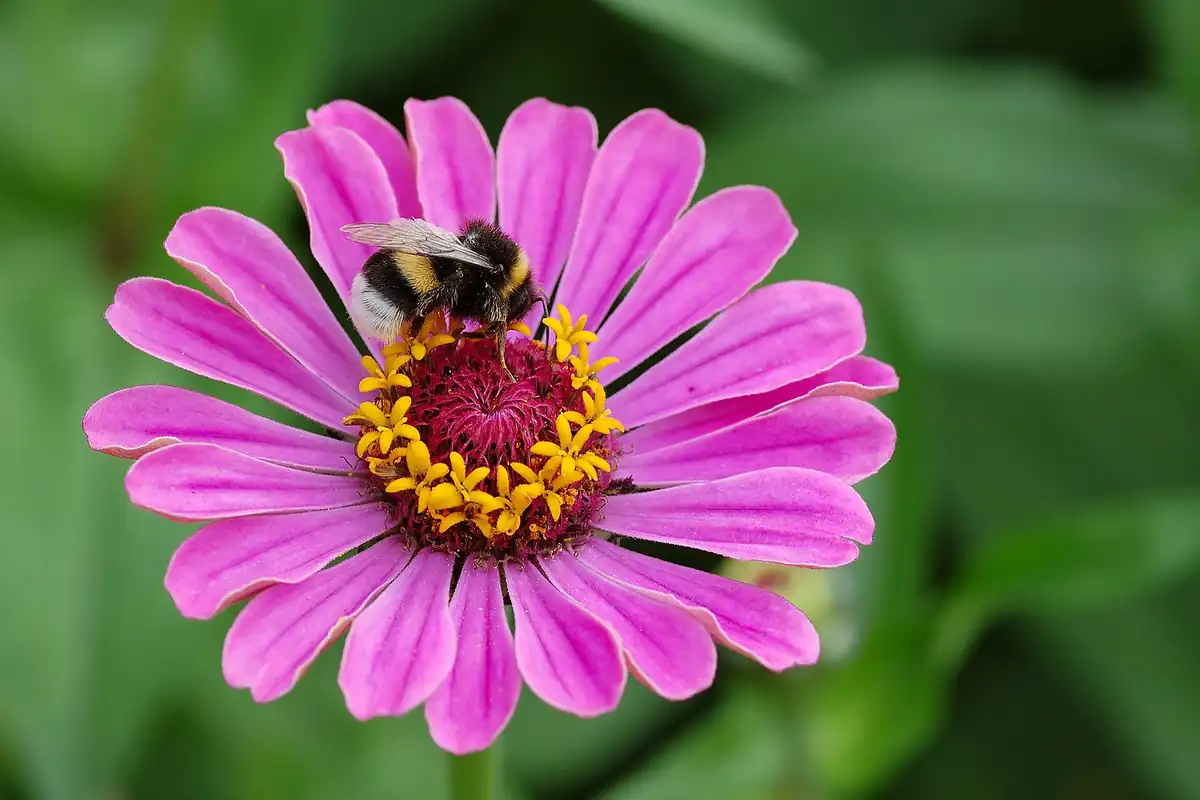
New Zealand has four bumble bee species, all introduced from Britain. They were brought in from England in 1885 and 1906, after farmers found that red clover, grown for stock, set little seed without long-tongued bees to pollinate it. The four that established are the buff-tailed bumble bee (Bombus terrestris), the garden bumble bee (B. hortorum), the large garden bumble bee (B. ruderatus) and the short-haired bumble bee (B. subterraneus). In Auckland gardens you will almost always be looking at the buff-tailed, with the garden bumble bee a distant second.
Buff-tailed bumble bee: the one you see most
Bombus terrestris is the most common and widespread bumble bee in New Zealand. Queens are big and round, with a dark body, two yellow bands (one at the front of the thorax, one across the abdomen) and a buff or off-white tail. Workers look similar but smaller, and often have a whiter tail. It has a short tongue, so it prefers open flowers such as daisies, zinnias and borage, and sometimes bites holes at the base of long flowers to rob the nectar.
Buff-tailed bumble bees nest underground, usually in old rodent holes, and their colonies are the largest of the four, sometimes a few hundred bees. They are also the species bred commercially for glasshouse pollination. If you have a bumble bee nest in your lawn, under a deck or in a compost bin, it is very probably this one. See bumble bee nest in the lawn.
Garden bumble bee: the long face
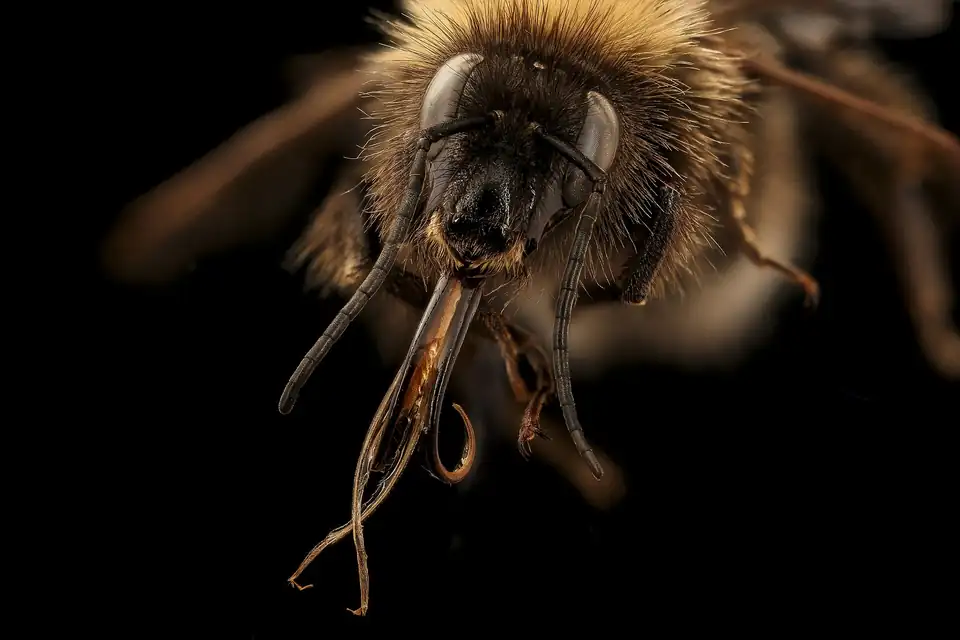

Bombus hortorum has three yellow bands (two on the thorax, one on the abdomen) and a clean white tail. Its face and tongue are noticeably long, as in the close-up above, photographed in Christchurch, and it favours deep flowers such as foxgloves, honeysuckle and comfrey. It nests on or just below the surface, in grass tussocks or under debris, with smaller colonies than the buff-tailed.
Large garden bumble bee
Bombus ruderatus is similar to the garden bumble bee but bigger, and some individuals are almost entirely black. It also has a very long tongue and is a strong pollinator of red clover. In New Zealand it is more common in the South Island and in farming districts than in Auckland suburbs.
Short-haired bumble bee
Bombus subterraneus has short, even fur and duller colouring. It became extinct in Britain in the 1980s, but survived in New Zealand, mainly in the South Island, and was used in an attempt to reintroduce it to England. You are very unlikely to meet it in Auckland.
Telling them apart in your garden
| Feature | Buff-tailed | Garden | Large garden | Short-haired |
|---|---|---|---|---|
| Yellow bands | Two | Three | Three, or almost none | Faint |
| Tail | Buff or off-white | Clean white | White | Pale |
| Face | Short | Long | Long | Medium |
| Usual nest | Underground hole | Surface, in grass | Underground or surface | Underground |
| In Auckland | Very common | Fairly common | Uncommon | Rare |
Don't worry about getting the species exactly right. All four behave much the same around people: gentle, slow to sting and seasonal.
How they differ from honey bees
Bumble bees are bigger, rounder and much hairier than honey bees, and they nest in small, one-season colonies started by a single queen. Honey bees form permanent colonies of tens of thousands, store large amounts of honey and swarm. A bumble bee nest needs no comb removal and leaves nothing behind. See the bumble bee guide and the bee or wasp page.
Bumble bees and native bees
Bumble bees share Auckland gardens with about 27 native bee species, all small and solitary. Both are worth looking after. Read New Zealand's native bees.
This note sits under Auckland bee removal, where the front page sorts out which bee jobs need a visit and which don't.
Quick answers
Are bumble bees protected in New Zealand?
There is no general legal protection for bumble bees, but they are valuable pollinators, and the NZ Bumblebee Conservation Trust encourages people to leave nests where possible.
Why do I see huge bumble bees in early spring?
Those are queens, newly out of winter hibernation and searching for nest sites. Workers that appear later in the season are smaller.
Do bumble bees die in winter?
The colony does. Only newly mated queens survive the winter, usually dug into soil or leaf litter, to start new nests in spring.